Focused on Parks Facilities? Click here to see our parks focused site.
Correctional Fitness in North America: Meeting Safety Standards and Compliance Goals
Correctional fitness in North America is no longer just about providing somewhere to work out. Today’s correctional facility gym must support rehabilitation, protect staff and inmates, and meet strict safety, security, and accessibility standards.
From tamperproof correctional equipment to ADA-compliant fitness layouts, every decision, from hardware to circulation paths, has compliance implications. Facilities need systems that are safe to supervise, built to last, and engineered specifically for the realities of correctional environments.
Outdoor-Fit designs correctional-grade fitness equipment to meet these expectations. Our bodyweight-driven, tamperproof systems help correctional leaders build safer, more accessible recreation spaces that align with policy, security, and rehabilitation goals across North America.
The New Standard for Correctional Facility Gyms in North America
Modern correctional facilities face three parallel responsibilities:
- Maintain safety and security in every space.
- Support rehabilitation and mental health.
- Demonstrate compliance with evolving standards and expectations.
A correctional facility gym must:
- Operate safely in unsupervised or semi-supervised environments.
- Use correctional equipment that cannot be dismantled, repurposed, or weaponized.
- Support ADA-compliant fitness where required, including accessible circulation and user access.
- Withstand constant daily use in demanding indoor or outdoor climates.
This is why most facilities in Canada and the United States are moving toward purpose-built, tamperproof systems designed specifically for secure environments.
Core Safety Principles for Correctional Fitness Design
In a prison gym, safety starts with the equipment, but it does not end there. Compliance is built on a combination of tamperproof engineering, predictable movement, and environments that are easy to supervise and maintain. This tamperproof, reinforced engineering is central to meeting safety expectations in correctional environments, ensuring equipment remains predictable, secure, and operational even under constant daily use.
Tamperproof Correctional Equipment
Traditional commercial gym equipment often introduces vulnerabilities: exposed cables, removable pins, open weight stacks, and adjustable mechanisms can be damaged, hidden, repurposed, or misused in secure environments.
Correctional-grade equipment doesn’t avoid these elements — it hardens them.
When cables, belts, or weight stacks are engineered correctly, with detention-grade materials and tamperproof systems, they can be fully appropriate for correctional settings. Outdoor-Fit equipment is designed around this principle.
Outdoor-Fit correctional systems use:
Hardened, tamperproof components
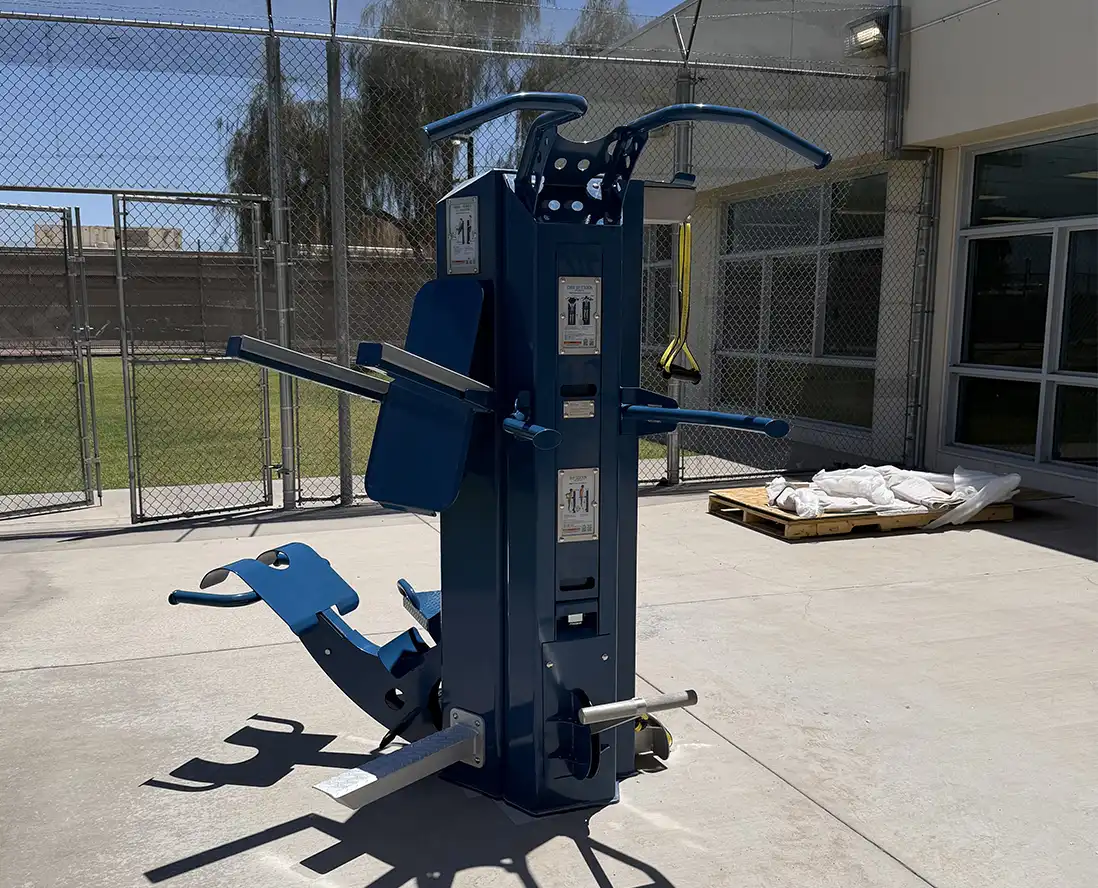
Our equipment uses reinforced cables, sealed internal mechanisms, and tamperproof stainless-steel Torx fasteners with rounded-head bolts. Internal systems are enclosed and protected, preventing dismantling or misuse while ensuring controlled, smooth exercise movement.
Heavy-gauge structural steel for security and impact resistance
Frames and moving components are built using 3/16”, 3/8”, and 1/8” heavy-duty steel to withstand constant, high-volume use and eliminate common failure points.
Engineered movement systems built for detention environments
Whether a unit uses cables, weight stacks, or internal resistance mechanisms, all components are fully hardened and secured. These systems provide the exercise experience people prefer while removing the vulnerabilities of traditional commercial gym machines.
Predictable Movement and Easy Supervision
Compliance in a correctional facility gym is not just about the equipment itself — it is about how that equipment behaves in real time.
- Biomechanically correct, repeatable movement patterns reduce the risk of injury and simplify supervision.
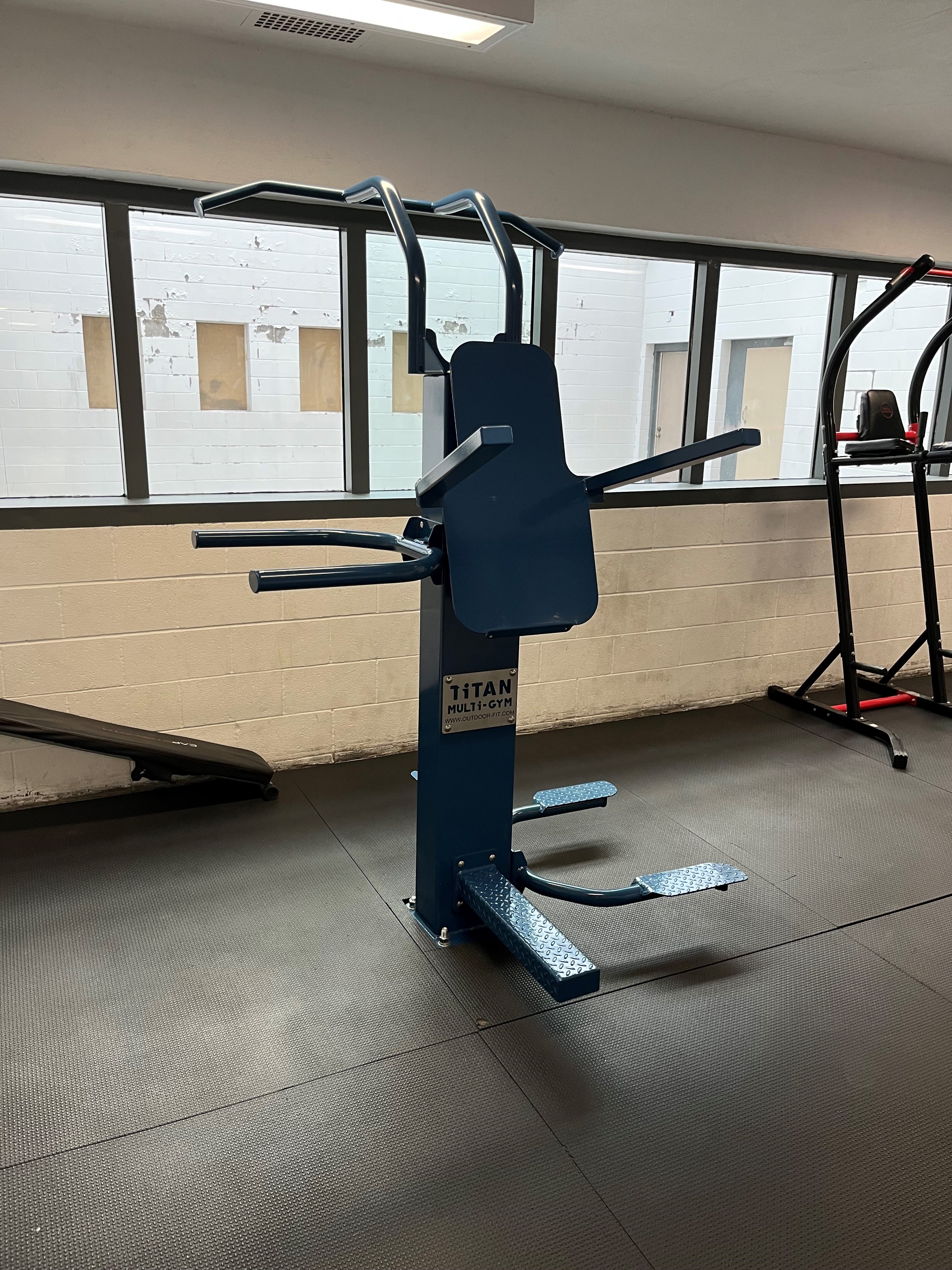
- Multi-user systems such as the Helios and Titan allow staff to monitor several inmates at once without complex sightline challenges.
- Static, no-moving-parts designs virtually eliminate unexpected failures that could create hazards or require urgent repairs.
When movement is predictable and visible, staff can focus on supervision and behaviour, not troubleshooting equipment.
Durable, Low-Maintenance Systems
A core component of safety standards in correctional environments is reliability. Equipment must remain safe and functional over many years with minimal intervention.
- Zinc-rich primers and UV-resistant polyester powder coating protect against corrosion in outdoor yards and harsh climates.
- Sealed mechanisms and welded frames reduce the need for frequent service and specialized repairs.
- Standardized fasteners and components simplify inspection and maintenance checklists.
Equipment that stays in service and in specification supports consistent programming — and consistent programming is essential for both rehabilitation and compliance reporting.
Designing an ADA-Compliant Correctional Facility Gym
In many jurisdictions, correctional leaders must also consider accessibility and ADA-compliant fitness when planning indoor and outdoor recreation areas. While specific legal requirements vary by region and facility type, several common design principles help support accessibility goals.
Accessible Circulation and Clear Routes
An ADA-aware correctional facility gym should:
- Provide clear, unobstructed circulation paths around equipment to accommodate users with mobility aids where required.
- Avoid narrow corridors or pinch points between stations.
- Maintain buffer zones that support both accessibility and staff response.
These circulation principles align with both accessibility goals and core security standards, making fitness areas easier to supervise and safer to manage.
Inclusive Equipment Selection
While not every piece of equipment needs to be accessible to every user, a well-designed correctional facility gym considers:
- Multiple grip heights and bar placements to accommodate different statures and abilities.
- Stable step-up or transfer points on certain stations.
- Stations that support partial weight-bearing exercises, such as assisted squats, incline push-ups, and modified rows.
Outdoor-Fit’s correctional equipment lineup includes multi-user systems and modular stations that can be configured to support a wide range of abilities while maintaining tamperproof, correctional-grade standards.
Visual Instructions and Programming Support
Accessibility also includes cognitive and informational access. Durable instructional placards with clear diagrams guide inmates through safe, repeatable movement patterns help standardize safe use across different inmate populations and staff teams, reinforcing both safety and compliance.
Building a Compliant Layout: Visibility, Access, and Flow
A safe and compliant correctional gym depends as much on the layout as on the equipment itself. Visibility must be the priority, with stations positioned away from walls, fences, and corners so they do not create concealment points. Entry and exit routes must remain open and clearly visible. These layout principles support security protocols, reduce incident risk, and align with operational requirements across the facility. For more information on Correctional Gym Equipment Regulations and State & Federal Guidelines, visit the page.
FAQ: Safety Standards, ADA Compliance & Correctional Fitness
What compliance standards do correctional gyms in North America need to follow?
Jail gyms in the United States and Canada must meet a combination of security, safety, and accessibility standards that go beyond typical commercial fitness requirements. The most common expectations include tamperproof construction, secure anchoring, predictable movement patterns, and ADA-aware circulation where required. Many facilities also expect equipment to align with ASTM safety and durability guidelines, which provide recognized benchmarks for structural integrity, corrosion resistance, and long-term reliability.
Compliance also includes how the gym space is designed. Facilities must ensure clear lines of sight, open approach routes, and layouts that prevent blind spots or concealment opportunities. In many jurisdictions, administrators must also ensure that accessible routes, approach zones, and transfer points accommodate users with mobility limitations.
To understand how tamperproof engineering supports compliance, see our pare: [Reliable Gym Solutions for Prisons & Correctional Facilities]
How do correctional leaders choose equipment that meets security and durability requirements?
Correctional administrators evaluate equipment through the lens of risk reduction, long-term performance, and predictability in secure environments. High-security facilities avoid commercial gym machines because they include cables, plates, removable hardware, and internal components that can be tampered with or misused.
Instead, leaders look for equipment built from heavy-gauge structural steel with fully welded frames, tamperproof stainless-steel fasteners, sealed internal components, and static, bodyweight-driven movement patterns.
Procurement decisions also consider maintenance cycles. Correctional-grade equipment lowers long-term maintenance costs by hardening or enclosing parts that typically wear out in commercial machines—meaning fewer belts, bearings, or pulleys that need regular servicing or replacement.
To support procurement teams, we offer a full step-by-step guide: [Procurement Guide: Purchasing Fitness Equipment for Correctional Facilities]
What layout guidelines help a correctional gym meet safety and supervision standards?
A correctional gym layout must prioritize visibility, safe flow, and predictable positioning of equipment. Stations should be placed away from walls, corners, and fencing so they don’t create concealment points. Circulation paths must remain open and unobstructed, allowing inmates to enter, move through, and exit the space in a predictable way that aligns with broader facility supervision protocols.
Buffer zones around doors, gates, and perimeter areas must be maintained to prevent crowding, blind spots, or congregation. In outdoor yards, equipment spacing must also account for environmental conditions and clear staff response routes.
You can review this related article that explains the security rationale behind layout choices: Correctional Facility Exercise Equipment